
Weaker GDT brings bearish forecast for the EU
The first two days of this week have been extremely quiet from our side. Add the relatively slow end of last week and the market feels back in summer mode. Everyone is looking for direction, but nobody seems to find what they are looking for, even when the numbers are pretty clear. Sellers were waiting on movement in Dublin, but didn't find the direction that helped them forward. This week most hoped the GDT would give them some clarity, but the first signals we receive are that this tender result doesn't really help the market either. Zoom out and most of the market data we see keeps supporting more directional trades. The fact that they don't materialize tells us the direction the data points to might not be the direction the market wants to accept.
Liquids: Big Impact on Production
Let's just look at some of the recent data. French milk collection came out with last week's numbers revised up (2% up YoY) and this week's collection still up 1% YoY – the French farmers continue to break last year's record collections. Germany's latest intake numbers still sit 1.6% above last year, although there you can argue the gap is closing faster than we expected. But ask around and we hear a lot of young calves being born. Dutch partners report more milk and expect collection to stay very positive. Apart from weaker collection numbers from the UK and Ireland, the continent feels strong and robust.
In Germany, butter production this year is up over 8% YoY, with last year already being a record year. We would need a significant decline over the next months to see that surplus get reduced. Cheese production is up almost 5% and SMP production up more than 17%. We said before that copy-pasting these figures onto other countries is too easy. But zooming out, the overall trend within the EU seems to be butter production up roughly 8%, cheese production up 2.5–3% and SMP production up 15%. And while expensive SMC and cream are showing up as significant production declines for SMP and butter in the German numbers over the last weeks, cheese production keeps running high. Once cream prices fell back below € 5,000, butter production showed surpluses again.
Prices for liquids are always a bit bouncy during the September–November months, so the next 10–12 weeks are going to be a ride. We continue to see expensive SMC prices impacting SMP production, while cream demand feels weak. We expect the impact on butter production to be felt during the most expensive cream weeks, but not over the full 10–12 week period. And cheese production numbers just remain strong, despite spot milk prices sitting slightly above their cost price. But if last week's production numbers come to market, cheese prices might take a hit.
GDT: Weak Result Points to EU Troubles
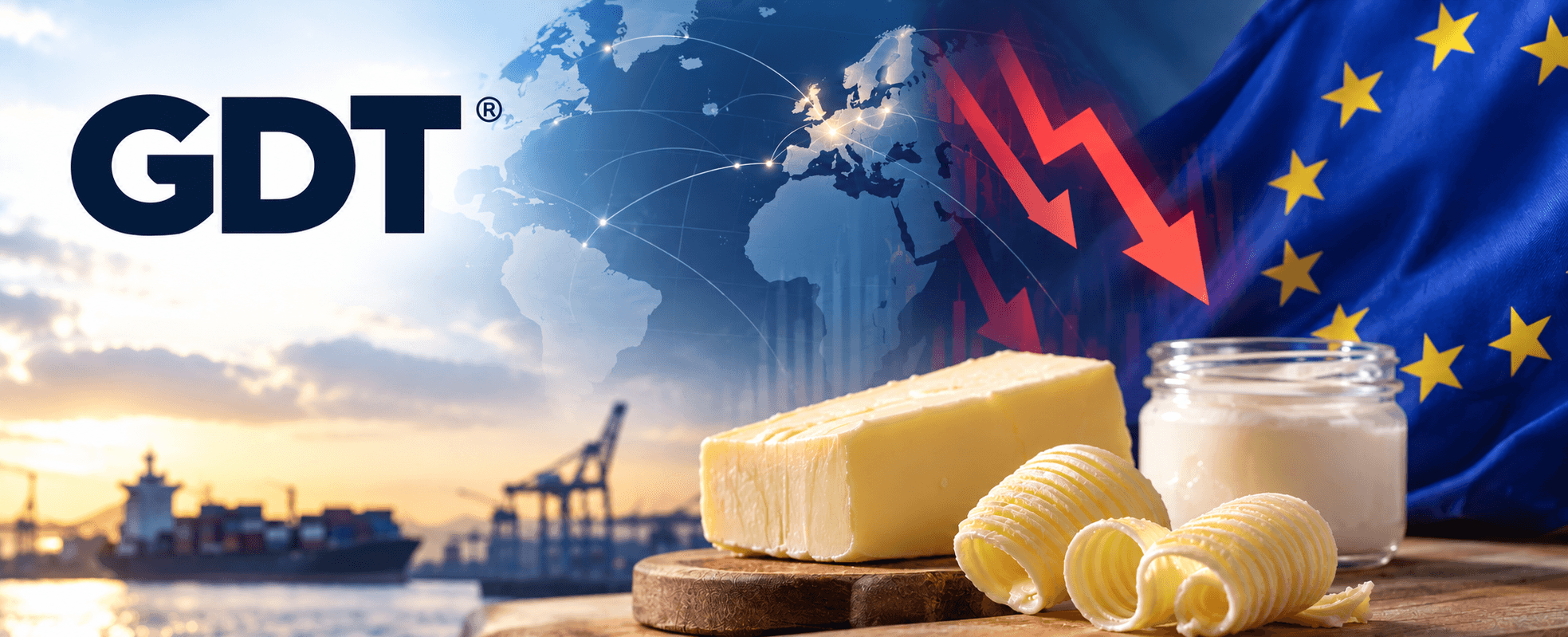
This week's GDT result can only be seen as a bearish warning for the EU. Prices took a dive, and not only for EU product – only SMP prices remained stable (in euros). A weaker USD helped EU SMP prices in euros to trade sideways, while in USD prices showed weaker. Butter prices from NZ and the EU are now trading on par, and the EU has lost its competitiveness versus NZ butter for the Asian market. From the EU, German butter didn't trade, Irish butter traded roughly at € 3,950 and Solarec's prices traded in the expected € 4,100–€ 4,150 range over Q4.
Looking at the cheese market we see a mixed result. Cheddar took an enormous bounce back up, but we can't find the logic there yet. After some negative results we expected a bounce, but 16.5% higher is a bit extreme for a market we haven't seen move. The other cheese results feel more in line with the market we see. Mozzarella moved 6% lower towards € 3,450 and we see other European cheese follow along with the bearish sentiment.
The powders showed less excitement. With WMP prices dropping 0.8% and SMP up 0.1%, we see on the GDT what we have been seeing in our markets all week: a standstill without a major pullback. The overall result for us shows the market still prefers protein over fat.
Looking at the market as a whole, the same trend can be seen on the EU markets and in the US, where the CME on butter and cheese keeps trading down. And while CME prices for NFDM are not breaking records yet, the uptrend remains visible when you zoom out. CME spot call data continues to show pressure on butter and cheese and upward pressure on NFDM, with spot prices back above $2.00/lb. In addition, the USDA WASDE increased its forecast for US milk production.
Butter: Back to Bearish
The last 7 days have caused us to critically look at our market bias. Our bearish view on fat might have kept our analysis from looking at the bullish signals. We admit we keep underestimating the impact of strong financial positions from producers, end users and traders who keep picking up cheap butter every time prices fall. The bottom of this market is far stronger than we expected it to be. But over the last days we have been seeing the same things we have seen over the last months: a heavy sales side for the next 4 months, with limited buyers willing to cash and carry. More offers for non-EU butter (mainly US product) for this or early next year arrival, and the same collective strategy from all major partners that have an impact on the market.
Take away the broken EEX futures, which lack liquidity due to uncertainty from the quotation commissions that are unreliable in their reporting duties. With the Pan-EU future gaining popularity, we might see a more reliable reference market for everyone willing to manage their risk outside of the physical market. Once those mechanisms are back, this market should continue to trade under the weight of its stocks and production output over the next 6 months. And where bearish butter used to mean a € 3,000–€ 3,600 price range, we have moved that bar up to € 3,600–€ 4,200.
Our current markets are roughly € 3,800–€ 3,900 spot, € 3,900–€ 4,000 for Q4 and € 4,150–€ 4,250 for Q1.
Cheese: Stepping Back
Over the last two weeks we have seen a very one-sided cheese market, represented only by offers and hardly any bids. And while a one-sided market usually leads to lower prices, over the last weeks that didn't materialize. Sellers kept their asking prices high, waiting for the buyers to return. And though we do hear some sales got done at higher levels, the sales side is starting to get a bit more nervous as the buy side isn't showing up.
We can only see so much downside, as cheese prices can't tumble without sharply correcting prices on SMP and butter. But as our view remains bullish on SMP, and we also don't expect major downside on butter, cheese prices need to find a balance between € 3,300 and € 3,450 to keep this market from turning into an up-and-down swinging rollercoaster. For now we expect prices to soften, but we would still see it more as a buying opportunity.
We would see prices for mozzarella now between € 3,400 and € 3,500, Gouda a few cents higher and Emmental between € 3,650 and € 3,750 for grating material.
SMP: Hitting the Pause Button (and Maybe Rewind)
The GDT is showing the exact same sentiment we have been seeing across our books. It seems China has been buying less this GDT, while the rest of Asia showed a strong presence. At these prices the conviction to continue buying disappears a bit, but not entirely. We continue to see worldwide support for higher SMP prices, but nothing moves up in a straight line of course.
Apart from the GDT, China remains important to watch. An interesting discussion between Nate Donnay and the StoneX team in China helped explain why Chinese SMP imports have not increased in line with expectations. China is producing more butter and cream domestically, leaving skim as a secondary stream which can be processed into SMP. This allows China to replace part of its imported SMP requirement with domestic production.
This does not mean imported SMP disappears from China. Imported product is still used for certain higher-end/premium products, where imported dairy ingredients also carry value from a quality and marketing perspective. But structurally, more domestic SMP means that stronger Chinese dairy demand does not automatically translate one-for-one into higher SMP imports.
For Europe, China therefore remains an important factor. If China continues taking sufficient volumes from Oceania, NZ should find enough outlet during its peak. If China proves to be more self-sufficient than expected, additional NZ volumes will have to compete elsewhere while Oceania is in full season and Europe is out. That would put more pressure on European SMP.
Fundamentally however, we still struggle to find strong bearish arguments for Europe. Milk collection is broadly around last year's levels despite the drought and heat stress, while considerably more product has already been absorbed by export markets. At the same time, we continue to hear that European feed and food buyers are relatively shortly covered. Ramadan, Chinese New Year and further Algerian requirements are also still ahead, leaving a considerable amount of demand open.
Our view has therefore become a little less outright bullish, but remains stable to bullish. China adds more uncertainty to the equation and a correction after the recent rally would not surprise us. But with European buyers shortly covered and significant export requirements still ahead, we still believe there is more demand that needs to come to the market. A correction before another step higher makes more sense to us than the start of a fundamentally weaker market.
Final Note
So where does that leave us? With a market that has all the numbers it needs and none of the courage to act on them. Milk keeps coming, butter and cheese production keep running, the GDT just told the EU it is no longer cheaper than NZ for fat in Asia – and still the sales side holds its price and the buy side sits on its hands. That is not a market in balance, that is a market in denial. And denial, in our experience, tends to resolve in one move rather than in ten small ones.
Our bias remains what it has been: fat under pressure, protein supported, cheese caught in between. The one thing we have adjusted is our respect for the bottom. Deep pockets keep catching the falling knife, and until that money runs out or finds a better use, the downside in butter stays limited to a range rather than a collapse. That doesn't change the direction – it changes the speed.
For the next 10–12 weeks, the advice is simple. If you are short fat, don't chase the swings; the sales side will come to you. If you are short protein, don't wait for the correction to be perfect; the demand that still needs to be covered is bigger than the correction that might come. And if you are in cheese, patience: € 3,300–€ 3,450 is where this market wants to settle, and a step below that is a level to buy, not to panic.
GFD, Good trading 🤝
The weekly report
Get it before it is anywhere else
Every market report, straight to your inbox the moment it is written. Butter, cheese, powder, liquids — pick what you actually trade.
Roughly weekly · Free · Unsubscribe any time