
Black Friday Deals for Christmas
Every year Black Friday starts a little earlier in our house. It used to be one Friday at the end of November. Now my wife gets the first “exclusive early access” emails in October, and by mid-November our hallway looks like a sorting centre. Apparently you save more if you buy more. The dairy market is going the same way. Christmas discounts used to come… at Christmas. A few days of closed plants, skeleton crews and trucks with nowhere to go, sorted out last minute with whoever picked up the phone. Now the market starts sorting, pricing and pre-selling the Christmas excess of milk and cream almost six weeks ahead, for a handful of days that every year turn into a logistical nightmare. And the flyer for Christmas 2026 is out. Raw milk, cream and SMC for the holiday weeks are on offer 25 to 40% below today’s spot. Not 2%, not “a little softer”. Twenty-five to forty. Even my wife started looking into buying some truckloads of SMC at € 2000 and cream just below € 3500.
Dairy isn’t the only one on sale. Tech stocks have had their markdowns too, and Nvidia even ran its own special: the share price dropped around 6% in a day after the CEO admitted an affair with a woman US officials suspect of spying for China. Spicy. But nobody needs one chip less because of it. Still, since then the share price has continued trading lower, but thats not because of a sudden change in supply and demand
Oil is the more interesting shop window. This week we learned the world is consuming less oil than it produces, and with tensions in the Middle East calming, the price is dropping fast. Still, analysts say buyers are probably still overpaying, because nobody is sure about supply. What if tensions flare up again? The oil price isn’t only a reflection of today’s supply and demand. It also reflects the risk management buyers apply to securing their stock. Or as my wife would put it: you don’t buy the extra winter coat because it’s cold today; you buy it because it might be.
That’s the distinction worth making this week. Some price moves are sentiment: the story changes, the demand doesn’t, and the discount gets bought back once the headlines move on. Nvidia, in our view, is that. Other moves are fundamental: the warehouse is full, and no headline empties it. Oil has both: a surplus underneath, with a risk premium on top.
The Christmas liquids are fundamental. A dairy producer doesn’t offer cream 40% under spot because it’s feeling gloomy. It does it because more milk is coming in than it has the capacity, staff or outlets to handle over the holidays, and that milk has to go somewhere. Then add what we heard last week: producers actively looking to place their cream on index contracts for the whole of 2027. That’s not a mood. That’s a twelve-month decision to stop making more butter themselves, or at least remove the pressure to maximise butter production.
So what does this sale tell us about what’s to come? Cheap Christmas cream doesn’t disappear. A good part of it gets churned and shows up as fresh butter in early January, right on top of a Q1 that already trades at €3,750 and stocks that are anything but tight.
And the risk premium? In butter you only find it at the back of the curve. Nov/Dec trades at €3,600, Q3 at €4,150. That €550 is the winter coat: buyers paying today for a “what if” next summer. Fair enough, as long as you remember the spring flush sits in between, and the flush has never been known for clearing fat.
The sentiment side, with buyers waiting at the door and sellers waiting for GDT, can flip in a single auction. The fundamental side won’t flip that fast. The trick with any Black Friday is knowing which discount is a bargain and which is just the shop getting rid of what it can’t sell. Let’s walk the aisles: butter, SMP and cheese.
Aisle 1: Butter. Everything must go.
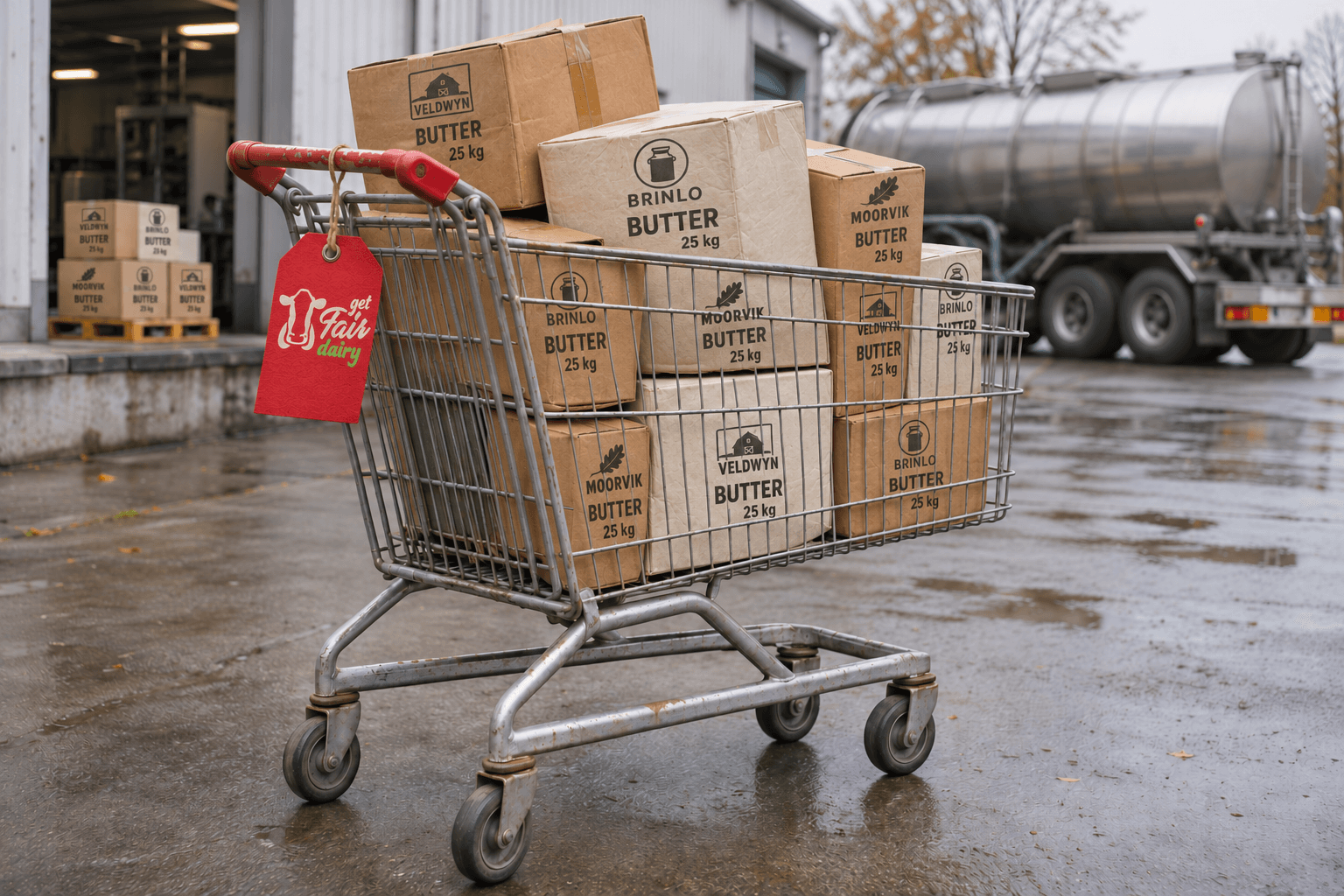
Every Black Friday has that one aisle with the big red signs. This year it’s butter. The market needs to clear stock and get rid of old product, and you can feel it in every conversation we have.
Sellers are still resisting a bit, but acceptance is slowly showing. For this year we hear prices between €3,450 and €3,500 FCA Ireland. For Q1, producers are actively selling at €3,700–3,750 in Western Europe and around €3,600 in Eastern Europe for Jan/Feb. That’s not a market waiting for a rally. That’s a market making room on the shelves.
The Christmas cream at €3,400–3,500 FCA Western Europe might sound cheap, and yes, it might lead to a few weeks of cheap butter production. But the lower cream offers are more a reflection of capacity issues than of willingness to make butter at € 3200.
Let's look at how we read the curve. The big premium further out doesn’t reflect an expectation that butter will rally again, even though many in the market still hope it will. It reflects risk management: buyers paying today for the winter coat they might need after next summer, and as my wife taught me, you buy your winter coat in the summer. The fundamentals underneath haven’t changed. The stock Europe has built will take months, and maybe years, to clear again.
Our butter curve:
| Period | Origin | Bid | Offer |
|---|---|---|---|
| December 2026 | NL/DE/BE | €3,500 | €3,625 |
| December 2026 | Irish lactic | €3,525 | €3,600 |
| Q1 2027 | NL/DE/BE | €3,700 | €3,750 |
| Q1 2027 | Irish lactic | €3,650 | €3,700 |
| Q2 2027 | NL/DE/BE | €3,900 | €3,975 |
| Q2 2027 | Irish lactic | €3,725 | €3,850 |
| Q3 2027 | NL/DE/BE | €4,150 | €4,200 |
All prices in €/MT. NL/DE/BE: if fresh max 30 days, if frozen max 6 months old.
Aisle 2: SMP. Flash sales only.
Walk one aisle further and the signs change. No “everything must go” here. In powder we’ve seen flash sales every few weeks: a short window, a sharp price, gone. And every time, it seems to attract more buyers than the last. In some cases, the cheaper powder sales are in combination with a similar volume butter from aisle 1.
The current market is hard to put a name on. On the one hand, demand for protein keeps outpacing production that is still declining. On the other hand, every time the buy side goes quiet for a few days, we see sharp corrections on the futures markets. And the curve says it all. EEX SMP runs from around €3,770 for December to around €3,600 for Q3 2027, a backwardation of roughly €170. Buyers are willing to pay a premium for product close by, but not a risk premium for anything further out. We see the same discount in the physical market.
It’s a strange thing to watch from the sideline. Butter has overhanging stock, a declining demand trend and worldwide competition at much sharper levels. Yet butter buyers pay a risk premium far beyond the cost of cash and carry: our own curve runs from about €3,550 in December to €4,150 in Q3. SMP has demand outpacing supply, falling stocks, no cheap alternative and a protein trend that keeps spreading. Yet here buyers only want to lock in future volume at a discount.
In Black Friday terms: the shoppers are buying winter coats for a summer that is very likely to be warm, and burning their old coat to keep warm this week, just ahead of the winter season. Or, as someone put it, they refuse to buy an umbrella right before the rainy season.
What’s on the shelf (largest positions)
Offers
| Volume | Period | Product | Price | Terms |
|---|---|---|---|---|
| 300 MT | Nov/Dec | W-EU SMP MH (Codex), fresh, 25 kg, export docs | €3,750 | ex plant |
| 300 MT | Nov | IE unstandardised SMP MH, min. 37% as-is, May 2026 production, BB/25 kg | €3,850 | DAP NL |
| 200 MT | Nov | BE SMP MH (Codex), fresh, 25 kg, export docs | €3,790 | FCA BE |
| 200 MT | Dec | Euroserum SMP MH, fresh, 25 kg, export docs + labels | €3,750 | FCA FR |
| 150 MT | Q1 2027 | Euroserum SMP MH (Codex), fresh, 25 kg, export docs + labels | €3,775 | ex plant |
| 150 MT | Nov | PL/CZ unstandardised SMP, 25 kg | €3,750 / €3,850 | FCA PL/CZ / DAP NL |
Bids
| Volume | Period | Product | Price | Terms |
|---|---|---|---|---|
| 300 MT | Q1 2027 | W-EU SMP MH/LH (Codex), fresh, 25 kg, export docs | €3,700 | ex plant |
| 300 MT | Q1 2027 | Any EU SMP (MH/LH, Codex/unst., BB/25 kg) | €3,650 | FCA NL/BE/DE/FR |
| 200 MT | Dec | Euroserum SMP MH (Montauban), 25 kg, export docs | €3,680 | FCA plant |
| 200 MT | Nov/Dec | Unstandardised SMP MH/LH, min. 36% as-is, BB/25 kg | €3,750 | DAP NL |
Aisle 3: Cheese. Everyday low prices.
Every supermarket has one aisle that never gets the red signs. Bread, milk, cheese: the staples. Retailers put them at the very back of the store on purpose, so you have to walk past every promotion to get there. They don’t need a Black Friday. They’re the reason people come into the shop in the first place.
That’s cheese right now. Prices are relatively stable, with the kind of electronic shelf labels that change every week, but only by a few cents, up or down. No flash sales, no clearance bins, no “everything must go”.
The reason is simple. Supply is steady, there’s little stock and offtake is relatively stable. A market like that doesn’t need flashy signs. Once or twice a year the market runs a proper promotion to balance stocks, but for now we expect those signs to stay in the storeroom.
You can see it in the curves too. Where butter climbs about €600 towards Q3 and SMP drops about €180, cheese barely moves from Q1 to Q2:
| EEX (Q1 → Q2 2027) | Bid | Offer |
|---|---|---|
| Gouda | €3,675 → €3,700 | €3,775 → €3,850 |
| Mozzarella | €3,675 → €3,700 | €3,800 → €3,850 |
| Cheddar | €3,850 → €3,925 | €3,950 → €4,025 |
Final thought: keep the receipt
Black Friday always ends the same way. The hallway fills up with boxes, the bank statement arrives, and somewhere in January the returns start.
The dairy market is no different. This year’s sale has three aisles. In butter, the warehouse is full and the discount is real, yet buyers are still paying for winter coats further down the curve, just in case. In SMP, the shelves are thinning and demand keeps coming, yet buyers refuse to pay for an umbrella, even if the weather forecast shows rain showers for the months ahead. And in cheese, nobody needs a sale at all.
What matters is knowing which price moves are fundamental and which are sentiment. Sentiment can turn in one auction, one headline, one quiet week on the buy side. Fundamentals take longer. Stock has to be eaten, milk has to be processed, and protein still has to be found. The Christmas cream will be churned, and the January butter will need a home.
My wife has given herself one rule for Black Friday that I’ve finally come to appreciate: it’s only a bargain if she would have bought it at full price. The same goes for butter, powder and cheese. Buy what you actually need, at a price you can explain in January, and keep the receipt.
GFD, Good trading 🤝
The weekly report
Get it before it is anywhere else
Every market report, straight to your inbox the moment it is written. Butter, cheese, powder, liquids — pick what you actually trade.
Roughly weekly · Free · Unsubscribe any time