A lot of Milk, A lot of Doubt and a lot of Fear
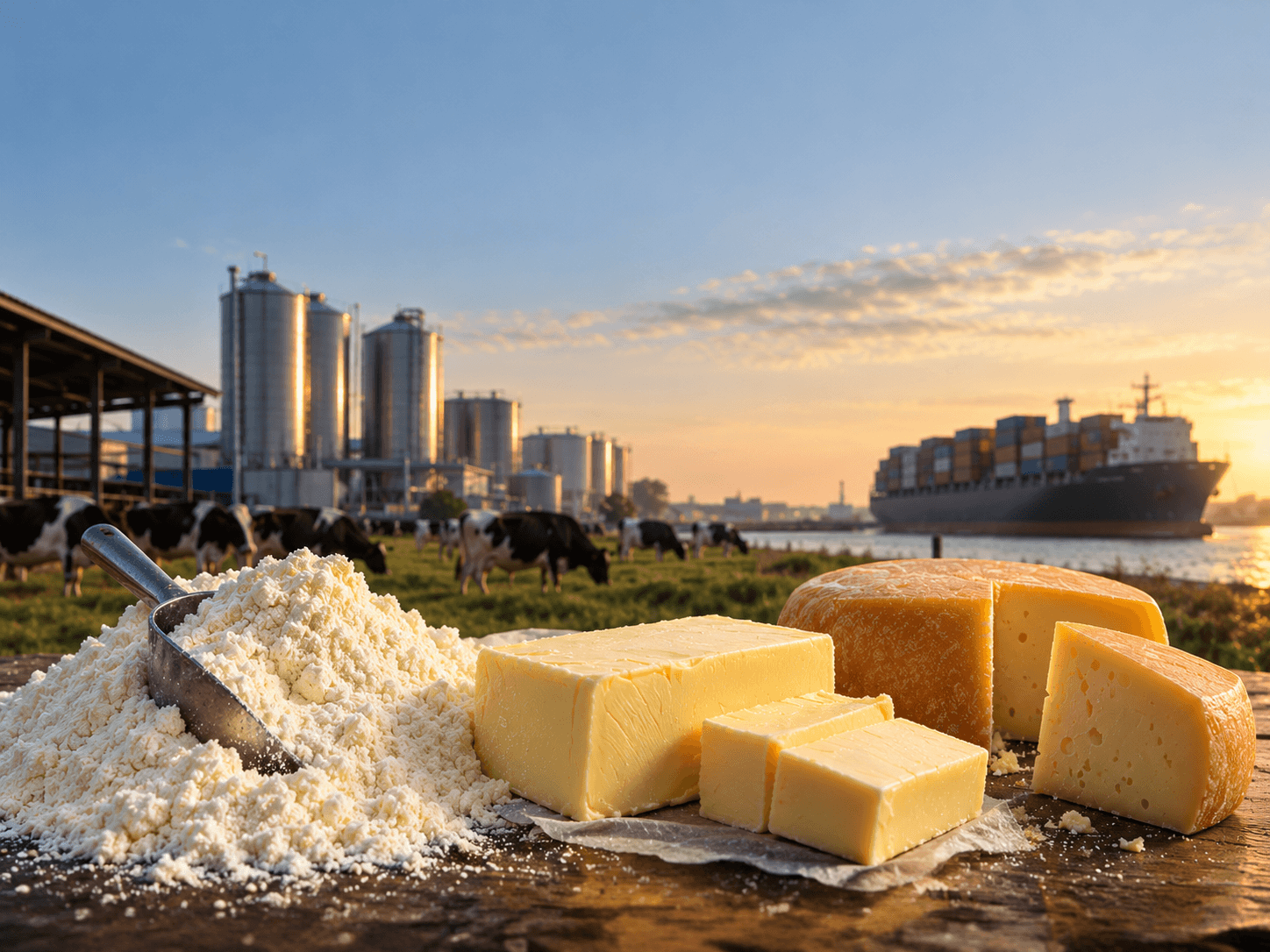
Last week was one of those weeks where the screens were busier than the phones. From our side it was relatively quiet on the brokering front: a single load of cheese and a couple of hundred tonnes of powders. Not a lot of trading, but a lot of information. The powder market rallied, dropped back, rallied again, dropped back, and then rallied and dropped once more, all within 72 hours. The butter bounce seems to be over, and cheese firmed a bit. Meanwhile, milk volumes in Europe are starting to ease though we would argue the supply is still on a high level for the time of year, while the US keeps delivering more, more, more.
With roughly eight weeks of trading left this year, we expect the market to stay volatile. The fundamentals don’t change every 72 hours, but the sentiment we see with our partners does. Our analysis points to a fundamentally bullish protein market, yet participants doubt there is more upside, and that doubt produced a small pullback in the last trading days. Butter is the mirror image. It remains well supported by fear of a quickly bouncing market, even though all the data points to prolonged pressure well into 2027.
We’ll keep repeating ourselves: long-term prices are set by fundamentals; short-term prices are set by sentiment. Last week the felt the influence of sentimental traders/producers and end users... let us take a look a the fundamentals once more.
A lot of Milk
Europe is finally taking its foot off the gas. Milk deliveries are starting to ease. French milk dropped a bit below last year, roughly 1,7% although collections are still higher than the data we can find for 2019-2024. With 2026 being an extremely strong H2 in milk collection, France is dropping back to normal levels. German milk numbers are also dropping below last year, though 0,2% can hardly be seen as a significant drop, especially as last year's numbers kept hitting +5% - +7%. With on-farm costs on the rise, we would expect surpluses to disappear from the EU scene, although increasing contract milk prices will keep farmers incentivised to milk as much as possible.
The US is a different story: more, more, more. Production keeps growing in September with 2.6%, components are growing even faster with 3.5%, and the extra milk has to go somewhere. It goes into cheese, butter and powder, and increasingly into export. But regions like NZ and Argentina are also still showing 1% production increases, with components in both countries increasing faster.
For European sellers, that is the key point. The global balance isn’t set in Europe alone. A slowing EU milk pool helps a bit to release the pressure, but as long as the US keeps pushing product onto the world market, it caps how far European prices can run.
A lot of Doubt: Powders
Three days, three rallies, three drops. Anyone who traded powders last week earned their coffee.
Fundamentally, we remain bullish on protein. Even a little less European milk means less milk going to the towers. With butter under pressure, the butter/SMP stream is also less attractive for processors, which further limits SMP supply. If prices could go from €1,850 last year to €3,700 ten months later with this year’s EU milk intake (that’s 2x!), think about what could happen once production falls. And the prices didnt rally due to less milk in the rest of the world. Everywhere we saw strong milk supply, but even stronger protein demand. From yoghurts, UF drinks to whey buyers switching to smp proteins.
However, the market doesn’t quite believe it. Every rally met sellers taking profit and buyers who had covered enough to wait again and hope for a correction. However small those corrections are, they are visible, and they push buyers away from the market again. Let’s be clear: nobody wants to be the one paying the top, and sellers don’t mind missing the top by €50/mt. The result was a pullback in the last trading days.
Our view is that doubt is a sentiment, not a fundamental. Doubt can delay a move, but it doesn’t cancel it.
EU SMP stocks did reach relatively high levels compared to the previous five years during this year's milk peak, and that justified the low prices. Since then, though, production has decreased over the last months and exports have increased, and the stock situation is starting to look a lot more like 2022. Add rising gas prices, which we also saw in 2022, and the ongoing growth in protein demand. Together, these lead us to expect the EU to go from well oversupplied to short supplied at record pace, despite still-solid milk collections.
That tells us demand has been very strong. With no sign of the protein demand trend slowing, we would argue that current forecasts below could turn out to be on the positive side and actual stocks Q1/2 next year can be a lot tighter.
On the buy side we see the same picture everywhere. Buyers are buying hand to mouth: small parcels, focused on locking in volumes for the next two to three months, and unwilling to pay €3,600+ for Q1 onwards. Producers, meanwhile, seem sold out for November and December, and January and February are starting to fill up too. Suppliers are looking at mid-Q1 onwards, while buyers are still looking for November/December offtake.
For us, the ONIL tender was a perfect mirror of how the market is trading. Judging by the offered volumes, all sellers seem to have decided to reduce their volumes. Some of the usual sellers even missed out entirely, with asking prices far above the winning levels. ONIL was happy to take less volume than expected, but the general consensus remains that they will have to come back for more. If they do, we expect them to pay more for their remaining needs.
A lot of Fear: Butter
After a hard correction in early October, when the market lost €400 within a week, butter bounced back up in the two weeks that followed. That bounce now seems to be over. Still, butter remains surprisingly well supported, even though we are heading into the new year with the highest stocks the EU has ever carried. Mid-December, more butter will be added to an already heavy stockpile, and the market seems happy to carry it.
The reason is fear, though at this point fear might be too strong a word. Everyone we speak to remembers how fast and how high butter prices moved last time, and nobody wants to be caught short if it bounces again quickly. We know we have written this sentence 1000th times, but it is the main and most important driver for buyers to keep buying. That fear keeps a floor under prices that is higher than the fundamentals justify. In regular years, it was mainly producers who kept stock when they expected a bounce. In recent years, traders and end users have joined the stockpiling crowd in large numbers. Even on export markets, we hear buyers are stockpiling at these relatively low prices.
Countries like China, but also countries in the Middle East, are buying far more butter than demand for fat alone can justify. Multiple people we speak to say the same thing: buyers are buying extra to sit out the next rally. But that rally can only happen if supply gets tight again. Conversations with our partners tell a very, very well-supplied story. End users are covered well into Q2 2027, traders have the largest stocks they have ever carried, and producers are offering Q2/Q3 stocks at this moment. The discrepancy between where supply sits and where demand needs it to be could almost not be any bigger.
The data doesn't tell a different story. Stocks remain at record highs. And although cream is trading above butter equivalent for the first time in months, the supply picture still points to prolonged pressure well into 2027. Fear can hold a price for a while, probably even a good while longer, but it can’t hold it forever. When the fear fades, the fundamentals will still be there.
Below is our most shared slide. For those keeping track: yes, all the levels went up again, and yes, we continue to believe the current forecast is still too conservative.
And a little bit of Cheese
The cheese market feels volatile and nervous. Zoom out, though, and most cheeses have been trading in a range of about €200/mt between their monthly top and bottom. SMP and butter traders nowadays sometimes have to process that kind of move in 72 hours.
That doesn’t mean cheese is easy. The situation does feel a bit more challenging. Supply seems to be tightening, and on Gouda we are facing issues with short-term collections. Looking at the market right now, we would argue there is more bullish momentum than bearish. But zoom out to the US and Europe is being undercut on the world market, which keeps participants fearful that a real rally can only last so long.
It’s very, very, very boring to forecast, but cheese is probably going to be very, very, very rangebound. Not exciting, but in this volatile and uncertain market, maybe it’s the place of rest every market participant needs every now and then.
Final Note: Eight weeks to go
Roughly eight weeks of trading are left in 2026, and we don’t expect them to be quiet. Powders have shown they can rally and drop three times in 72 hours, butter is being held up by sentiment more than by fundamentals, and buyers and sellers are still looking at completely different months to sell/buy. That’s a recipe for volatility.
Year-end makes it worse. Liquidity thins out, positions get squared, and every small parcel suddenly looks like a market signal. Expect sharp moves on little volume, and expect a lot of them to be reversed just as quickly.
So in short: a lot of milk, a lot of doubt, a lot of fear, and a little bit of cheese to rest on. Our compass hasn’t changed. On protein, we believe the doubt will eventually give way to the fundamentals. On butter, we believe the fear will eventually give way to the stocks. The question isn’t if, but when, and that “when” is exactly what sentiment decides.
Long-term prices are set by fundamentals, short-term prices are set by sentiment. For the next eight weeks, expect sentiment to do most of the talking.
Good trading 🤝
Wouter Reijntjes
Get Fair Dairy
The weekly report
Get it before it is anywhere else
Every market report, straight to your inbox the moment it is written. Butter, cheese, powder, liquids — pick what you actually trade.
Roughly weekly · Free · Unsubscribe any time